 MyAAGrapevines.Com - Story Of AA
The Story of Alcoholics Anonymous — From Oxford Group to Big Book to 2026
AA did not begin on a barstool. It began in a Oxford Group meeting. If you own an original 1939 Big Book — red cloth, white jacket, $3.50 in 1939, now a fortune — you own the proof that a few funny, broken stories can change the world.
Oxford Group — 1908 to 1934: The Four Absolutes
1908, Keswick, England. Lutheran minister Frank Buchman has a spiritual experience. He builds a movement around house parties, sharing, and guidance. Officially the Oxford Group (because early members were Oxford students), later Moral Re-Armament (MRA).
Doctrine was simple:
- Absolute Honesty — not just not lying, but transparent.
- Absolute Purity — of motive, of body.
- Absolute Unselfishness — you check selfishness daily.
- Absolute Love — unselfish love for others.
Method: Daily quiet time, listen for God’s guidance, share your sins in meetings, make restitution. No hierarchy. Bill Wilson later wrote: “The Oxford Group gave us the ideas, but kept the absolutes. We made them aspirations.”
Ebby Thacher brings Bill to Oxford Group meetings at Calvary Church, New York, December 1934. Bill loves the fellowship, hates the absolute language — he’s too guilty to be absolute anything. Dr. Bob Smith had been in Oxford Group since 1933 in Akron, sponsored by Henrietta Seiberling. Early Akron AA was an Oxford Group meeting: you got down on knees, surrendered, made a list, confessed, made amends.
1937 — Bill and Bob split from Oxford Group. Two reasons: Oxford Group wanted to save the world (prohibition, politics), AA wanted to save drunks only. And Oxford Group required you to accept Jesus as your higher power publicly. Bill wanted to allow the agnostic — hence “God as we understood Him.” That phrase first appears in a 1938 draft of How It Works.
1935 — The Meeting on Main Street
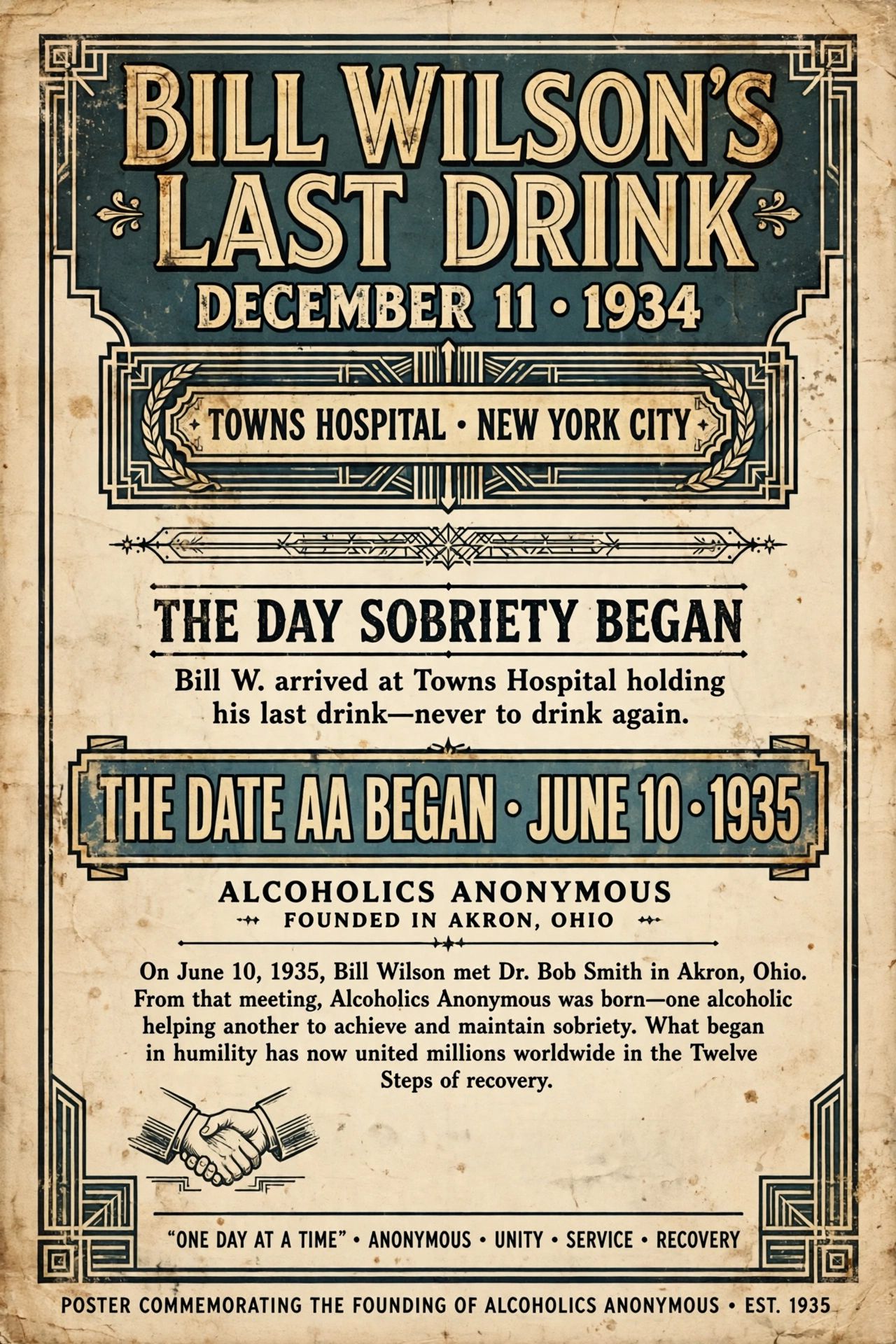
May 12, 1935, Akron, Ohio. Bill fails at a proxy fight, broke, wants a drink. He calls Walter Tunks from Mayflower Hotel lobby, gets Henrietta Seiberling, who introduces him to Dr. Bob. They meet at Henrietta’s gatehouse at 30 minutes. Bob is drunk, but agrees to talk 15 minutes. Six hours later, Bob says: “I’ve been doing it wrong. I thought religion was the answer. It’s this — one alcoholic talking to another.” June 10, 1935, Bob’s last drink — AA’s founding date. Bill Dotson, AA #3, gets sober in Akron City Hospital — Bill and Bob work with him in shifts, no preaching, just stories.
1939 — The Big Book: How It Was Written
1938, Newark, NJ. Hank Parkhurst offers his office at 17 William Street. Bill writes longhand, Ruth Hock types. Chapters are read at Tuesday night meetings at 334 1/2 Clinton Street for approval. Members argue over “must” vs “suggested.” Bill loses — “suggested” stays.
The Original Manuscript: 4,730 copies, Works Publishing Co., red cloth, white dust jacket with “Alcoholics Anonymous” in red script. No index. 29 stories — your 1939 has them. “The Unbeliever” (Jim — the agnostic who thought he could control), “The European Drinker” (cut in 1955 because it glorified drinking in Paris), “Annie the Cook” — a Black woman cook from Akron who kept getting drunk on cooking sherry, told with brutal humor. Bill picked stories to show types: businessman, farmer, salesman, woman (only one in first edition), young, old.
Chapters — The First 164 Pages Bill Said Never Change:
- Doctor’s Opinion — Silkworth: “allergy of body, obsession of mind.” Medical cover Bill needed to sell to doctors.
- Bill’s Story — Towns Hospital, the light, Ebby’s “I’ve got religion.”
- There Is A Solution — 100 men, “we” not “I” — fellowship as power.
- More About Alcoholism — Jaywalker, the man who can’t stop eating — the mental obsession.
- We Agnostics — Written for Hank who said “God is bunk.” “Lack of power was our dilemma.”
- How It Works — Pages 58-71, the Steps. The Promises page 83-84.
- Into Action — Inventory, amends, practical. Page 76 night inventory, page 86 morning.
- Working With Others — Sponsorship before the word existed.
- To Wives, Family Afterward, To Employers, Vision For You — Dated now, but shows AA wanted everyone.
Why the Stories Change Every Edition — And Why Funny Is Best
Bill said: “The chapters tell how; the stories tell that it works.” Each edition updates to reflect who AA is now:
1st 1939 — 29 stories: All white, male, Northeast. Humor is gallows: “I switched to beer to control my champagne drinking.” “The Man Who Mastered Alcohol” — title itself is a joke, he didn’t.
2nd 1955 — 42 stories: Adds Marty Mann “A Woman’s Story,” “They Stopped In Time” (youth), keeps “He Sold Himself Short” (Earl H.) — now a circuit speaker in your /php/speakers.php archive. Adds Twelve Traditions appendix for first time after 1950 Cleveland adoption.
3rd 1976 — 42 stories: Adds “A Late Start” (old-timer sober at 70), “Gratitude In Action” — removes 8 originals deemed too racist/sexist.
4th 2001 — 42 stories: 8 retained from 1939, 34 new — deliberately inclusive: “The Color of Fear” (Native American), “A Young Man’s Story,” “The Lawyer, The Prisoner,” “Safe Haven” (gay member). Still, your 1939 has best punchlines because they weren’t edited for sensitivity.
Collectors track which survive. “Doctor, Alcoholic, Addict” (Paul O.) and “My Bottle, My Resentment and Me” appear in both Big Book and speaker tapes.
Joe & Charlie Big Book Study — Speaker Study That Teaches The Margins
1970s, Little Rock. Joe McQuany (Big Book author “A Different Slant” in 3rd edition) and Charlie Parmley run 4-day seminars. They teach you to mark your Big Book: Underline page 20 “We... no musts,” circle page 44 bedevilments, page 62 “self-will run riot,” page 86 “We ask God to direct our thinking.” Every AA book after 1939 is footnotes to those marks. That’s why /php/speakers.php has 25+ hours of Joe & Charlie — it’s the user manual for your 1939.
Books After the Big Book — Complete AA Library
1953 — Twelve Steps and Twelve Traditions: 24 essays, first serialized in Grapevine 1952-53. Bill explains why Steps work, why Traditions protect us from ourselves.
1957 — Alcoholics Anonymous Comes of Age: Bill’s history, Rockefeller dinners, how Traditions saved AA from money and fame. Last solo book Bill wrote.
1962 — Twelve Concepts for World Service: Service structure upside-down — groups have final authority, Conference is trusted servant.
1967 — As Bill Sees It (The AA Way of Life): Bill’s Grapevine “Language of the Heart” letters.
1975 — Living Sober: From Grapevine “Practical Experience” columns — how to not drink at wedding, work party, holidays.
1980s-2020s — Came to Believe, Daily Reflections (1990), Experience Strength Hope, Language of the Heart, Thank You For Sharing: All best-of Grapevine — exactly what you archive in 1940s.html to 2020s.html and fullarchive.html — stories curated by decade.
Spanish La Viña 1996, French 1950s, 100+ languages now — but all start from your 1939 first 164 pages.
1944 — Grapevine Is Born: Meeting In Print
June 1944, 30 Vesey Street, Manhattan. Six members, mimeograph, 8 pages, 1,200 mailed. Bill calls it “meeting in print.” Wartime letters from Pacific, cartoons, “Mail Call.” 1946 — Twelve Traditions first appear here, one per month. 1971 — Bill dies, March Grapevine memorial is all letters. 2020 — April cover empty chair, PDF sales +400%, Zoom Mail returns. Today full archive 1944-06 to 2030 preserved in /images/aa_grapevines/ — every slogan timestamped: “One Day at a Time” 1955-04, “Let Go and Let God” 1962-08.
Why Your 1939 Fortune Matters
You paid a fortune for red cloth because you know what Bill knew: a funny story saves a life faster than a lecture. The best Big Book stories are funny because ego finally small enough to laugh at “I mastered alcohol — then it mastered me.” That’s why originals beat later sanitized versions. You don’t frame it to brag — you read it to remember what AA was before it became polite.
All books after — 12&12, Concepts, Living Sober, Daily Reflections — are attempts to explain what Bill couldn’t fit in 164 pages. Big Book is textbook; rest are footnotes from members who lived it, many now speakers in your archive.
Search below by year or title if you add book covers to /images/aa_books/. This story page is preserved for historical and educational purposes, same as /php/aa_books.php and fullarchive.html.