1950s — AA Comes of Age: From Cleveland to St. Louis
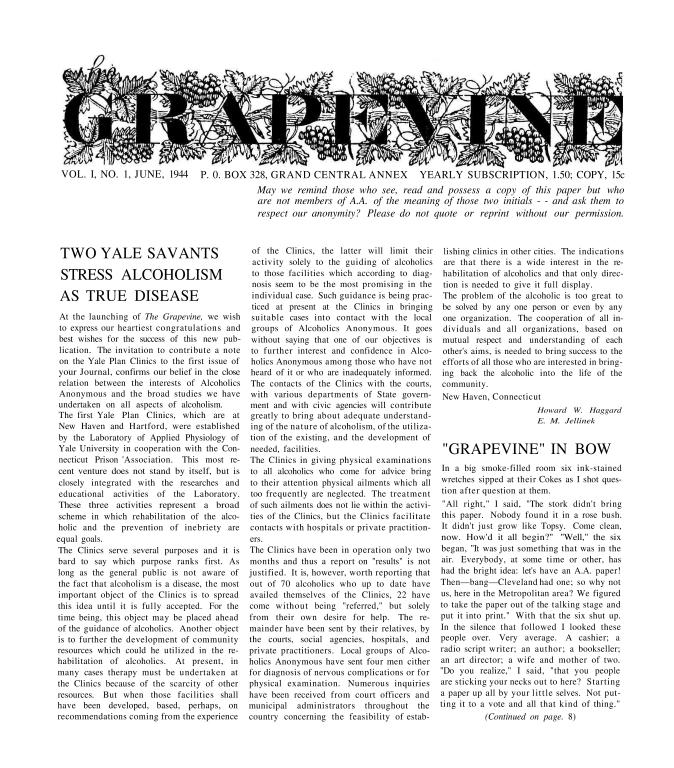
The 1950s is the decade AA stops being a rumor and becomes an institution. In July 1950, Cleveland hosts the First International Convention — 3,000 alcoholics filling the Music Hall, Bill W. and Dr. Bob side by side for the last time in that scale. The Saturday Evening Post articles are behind us. AA is no longer a desperate experiment in Akron and New York — it is respectable, welcomed by doctors, clergy, and even the State Department. The Grapevine, which began as a six-member mimeograph in wartime Manhattan, now prints 40,000 copies a month and is mailed to foxholes, prisons, and new groups springing up from San Francisco to Christchurch.
This respectability changed what the magazine could say and how it looked. Paper rationing is over. The cramped, text-heavy wartime pages give way to crisp mid-century illustration — clean ink lines, spot color, a martini glass sweating on a suburban coffee table, a housewife staring out a picture window, a salesman with a hat in his hand. The art is optimistic and conformist on the surface, but inside the stories are still razor-sharp: returning veterans who can't stop after V-J Day, secret drinking by wives on tranquilizers, traveling men who find meetings in motel basements. The war taught AA about trauma; the 50s taught it about loneliness behind the white picket fence.
International Conventions and Mini Sheets
Two conventions bookend the decade. Cleveland in 1950 proves AA can assemble without falling apart. Twenty thousand? No, only three thousand — but the Twelve Traditions are ratified there by voice vote, a moment Bill later called the second founding. Then in July 1955, St. Louis — the 20th Anniversary Convention — draws more than 5,000 to the Kiel Auditorium. It is the moment Bill and Lois and the early friends turn to see thousands of faces where once there were only dozens. It is also the last time Dr. Bob appears in Grapevine photos; he will die November 16, 1950, and the November 1950 and February 1951 issues become quiet memorials.
For archivists, the 1950s hold two special artifacts: the mini sheets. The Grapevine printed souvenir mini editions for Cleveland — often cataloged as 1951-00 or 1950-07 mini — and again for the 1957-02 and 1957-06 period when regional conferences exploded. These are not full issues: four pages, folded, pocket-sized, handed out at registration tables. They contain condensed programs, Bill's short talks, and attendee lists that now read like a roster of AA's first elders. In this decade's scan you will find them listed as 1951-00 and 1957-02 — keep them; they are rarer than regular issues.
Twelve Steps and Twelve Traditions is Born in the Grapevine
Perhaps the most important literary event of the decade happened monthly, not in a book. Starting in 1952, Bill wrote a series of articles for the Grapevine titled "Twelve Steps" and later "Twelve Traditions Illustrated." Each month he took one Step, explained it from personal experience, answered letters challenging it, and revised it on public paper. Readers wrote back — angry, grateful, confused — and Bill answered in the next issue. By mid-1953 the series was collected and expanded into the book Twelve Steps and Twelve Traditions, published by AA Publishing. If you pull the 1952-03 through 1953-12 covers from this collection and read them in order, you are reading the first draft of the book AA still studies in every step meeting.
That serialization explains why 1950s covers often feel didactic. The interior layout changed: more white space, pull-quotes from the Steps, small vignettes of how a Tradition works in a real group fight — the treasurer who drinks, the member who breaks anonymity on radio. Tradition One and Tradition Three get multiple covers. 1955-07 shows St. Louis bunting; 1955-08 shows Bill's address about "I am responsible." The Fellowship learns to govern itself in these pages before it votes in conference.
What You'll See on 1950s Covers
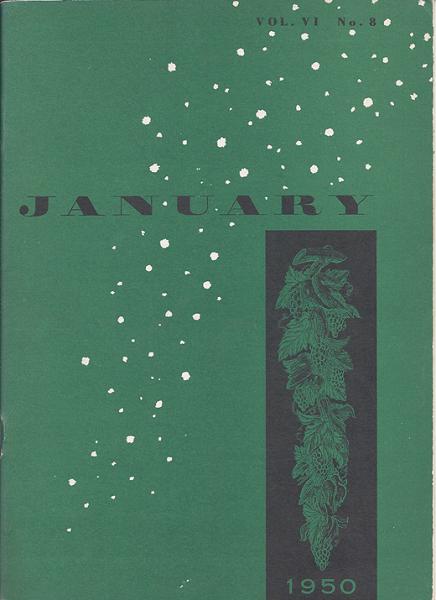
Visually, the 1950s are a bridge. 1950-52 still have hand-lettered titles, almost newspaper-like. By 1953-54 the titles become set type, covers add a two-color process — burnt orange, teal, mustard — very Saturday Evening Post, very Reader's Digest, which is intentional: Grapevine wanted to sit on a doctor's waiting table without shame. By 1956-59 covers experiment with photography for the first time: an empty chair, a coffee pot, a road at night, but never faces — anonymity is still drawn, not photographed.
Themes shift year by year. 1950-51: gratitude and aftermath — letters from Pacific, Korea begins. 1952-53: the Traditions explained to a growing membership worried about money, property, prestige. 1954-55: the 20th Anniversary, history, telling the story before it fades. 1956-57: youth — the first stories titled "I was 19 when I joined," wives speaking without "Mrs. John" masking, first explicit stories from Black members in Detroit and Los Angeles, still rare but present. 1958-59: "Language of the Heart" — Bill's later Grapevine essays that will be collected in 1988, meditations on leadership, humility, and what happens after sobriety arrives.
Language of the Heart and Lasting Legacy
Beyond the monthly issues, the 1950s give us Bill's most quoted Grapevine pieces: "The Language of the Heart" (July 1951), "Anonymity is the Spiritual Foundation" (late 1950s editorials), and early versions of "Why We Need The General Service Conference" which would lead to the Conference structure in 1951 and its test in 1952. The Grapevine ceases to be just a newsletter and becomes the daily conscience — printing disagreement without schism. You can feel that in this decade's archive: letters are longer, dissent is published, humor returns after wartime austerity.
For today's reader, preserving these 120 issues matters because they show a movement learning to stay sober after success. AA went from 100 members in 1940 to 6,000 in 1950 to over 100,000 by 1959. The Grapevine was the thread that held that growth together when telephones were expensive and long-distance driving was still an event. Click any cover below to enlarge, search by YYYY-MM (e.g., 1953-06), and read the decade when AA proved it could cross the Atlantic, survive its founders' fame, and still speak in one drunk's voice to another. This is not nostalgia — it is the operating manual written in real time.