1970s — Loss, Growth, and Earth Tones
The 1970s began with loss and ended with reinvention. When Bill W. died on January 24, 1971 in Miami, the Fellowship held its breath. For many members he was the last living link to that kitchen table in Akron in 1935. The Grapevine did not try to explain it. The March 1971 memorial issue contains no editorial, no biography — only letters. Page after page of letters from members who never met him but owed him their lives. That restraint is the message of early Seventies AA: keep it simple, let the Fellowship speak.
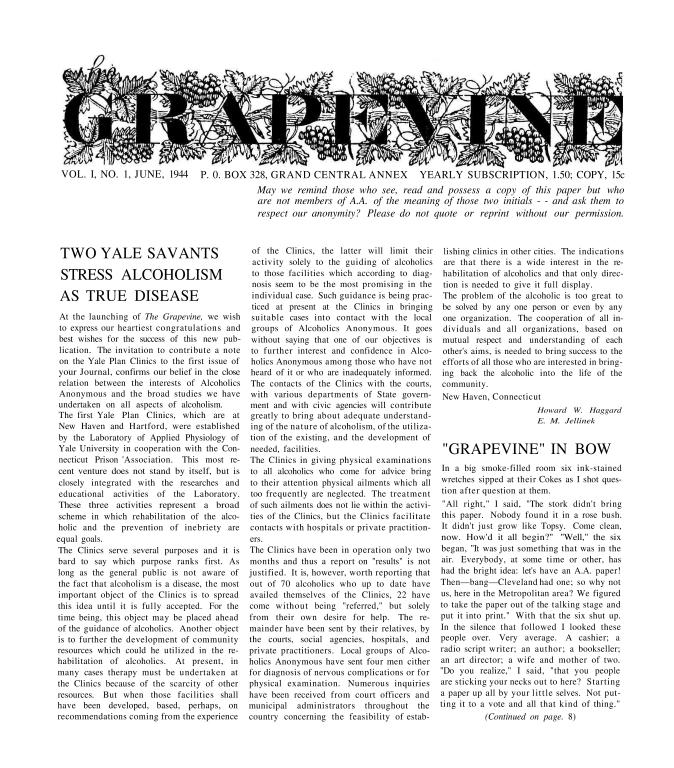
Behind that quiet grief, AA was exploding. Treatment centers opened on every highway. The 28-day Minnesota Model sent thousands of newly sober patients to their first meetings with a Big Book and a Grapevine subscription card. Courts began referring drunk drivers to AA. Membership that had been 200,000 at the start of the Sixties passed 500,000 by 1970 and hit 1 million by 1973. The Grapevine circulation mirrored it — peaking at 85,000 monthly copies in 1973, the largest it would ever be in print. If the 1940s Grapevine was a mimeograph and the 1960s was spot-color art, the 1970s was monthly color photography for the first time.
Earth Tones and Everyone Belongs
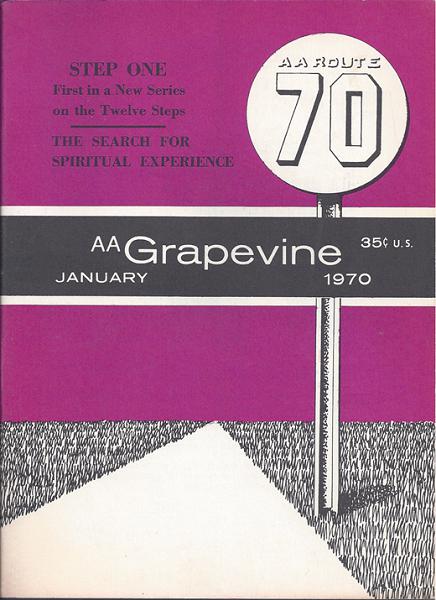
Look at the covers in this collection and you see the palette shift — avocado, burnt orange, harvest gold, chocolate brown. Inside, the language shifts faster. The Seventies Grapevine finally prints stories that could not have appeared a decade earlier: “The Wife Who Drank,” “I Was a Teenage Drunk,” “Gay and Sober,” “A Native American in AA,” “Behind Walls — San Quentin.” Women, young people, Black, Latino, Indigenous, gay and lesbian, prisoners, and later Vietnam veterans tell their stories in their own words. The magazine's unofficial edit line — “Everyone belongs if they want to stay sober” — becomes official.
It also becomes more practical. 1973 to 1976 are the “How I do it” years: “Living Sober” starts as a monthly Grapevine column of practical tips — what to do at a wedding, at a funeral, when the kids scream — collected later into the Living Sober booklet in 1975. That booklet and the slogans you still hear today appear here first: “Keep It Simple” in November 1973, “First Things First,” “Easy Does It.” The December issues each year run a year-end inventory that many groups still read in December meetings.
1975 — Denver and the Mini Sheets
The 40th Anniversary International Convention in Denver, June 1975 — 19,800 attendees — is AA's first truly massive stadium event. The Grapevine team flies from New York with a portable press. They print three different mini variants that week — programs 1975-05, 1975-06, and 1975-07 in the mini archive — pocket-sized 4-page sheets with maps, bus schedules, and a daily thought. Those Denver minis are now among the most traded collectibles because Denver introduced the coffee cup and the hug as convention ritual.
Denver also marks the end of an era. Lois W. gives what would be her last major public talk. Dr. Jack Norris, the non-alcoholic chairman of the General Service Board, speaks about cooperation with the professional community — a theme that would define the second half of the decade as doctors, judges, and counselors began filling AA rooms.
1977–1979 — The Magazine Becomes a Magazine
Open a 1970 issue and a 1979 issue side by side and you are looking at two different publications. Early Seventies copies are still tabloid newsprint, folded, stapled. By 1977 the Grapevine Board approves a complete redesign: perfect-bound spine, coated stock, glossy cover, inside black-and-white photographs with captions, and by late 1979 the navy blue border that still frames every cover today. The editorial shifts from news to stories. “AA Around the World” becomes a monthly photo essay. Letters are edited shorter, more members per issue.
That redesign is about survival. With a million members worldwide, the Fellowship can no longer be served by a newsletter. It needs a journal. The 1978–79 issues introduce departments you recognize now: “At Wit's End” humor, “Dear Grapevine” Q&A, YPAA notices, correctional facility addresses, and the first formal “Grapevine Calendar.” The last cover of the decade, December 1979, is a simple blue-bordered photograph of a winter street lamp — no text, just light. After a decade that began with a memorial, it feels intentional.
Why the 1970s Covers Matter
For collectors and historians, the Seventies are the bridge. You can trace when women's stories move from “For Wives Only” to the front of the issue, when the first story by an openly gay member appears in April 1974 without a pseudonym, when the language changes from “alcoholism” to “recovery,” and when photography replaces illustration. The issues from 1972 to 1974 are also the last to carry cigarette ads — a detail social historians note.
120 issues from the 1970s. Search below by YYYY-MM — for example 1971-03 for the Bill W. memorial, 1973-11 for Keep It Simple, 1975-06 for Denver. Click any cover to enlarge. All images are from the archive and preserved here for historical and educational purposes.