The 1980s — Maturity, Global Conscience, and Fifty Years Sober
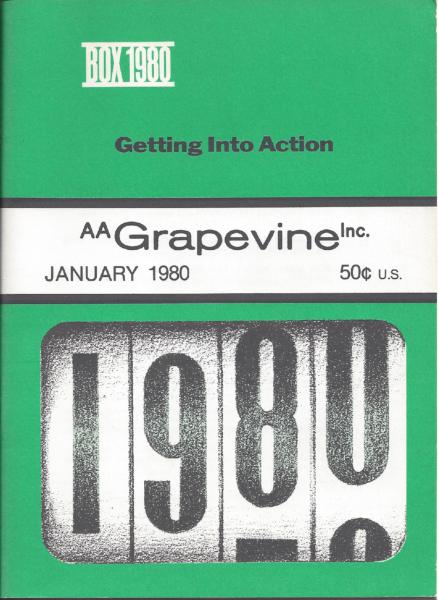
By January 1980 AA was 45 years old, with more than 32,000 groups in over 100 countries. The Grapevine entered the decade with a new confidence: full-color photographs, candid family tables, coffee pots and meeting rooms, and an editorial voice that trusted a story from Des Moines could help a drinker in Gdansk.
This archive holds that passage from 1980-1989, a decade that moved AA from American adolescence to worldwide responsibility — from Reagan-era growth to stories smuggled out of the Iron Curtain, from the birth of La Viña to the 50th anniversary in Montreal.
Forty-Five Years and Thirty-Two Thousand Groups
The June 1980 issue ran a growth timeline: 2 groups in 1939, 100 in 1945, 3,000 at the 20th anniversary in St. Louis, and by 1980 more than 32,000 groups and an estimated 1.2 million members. GSO was at 468 Park Avenue South and the World Service Meeting was truly global.
Inside 1980-1983, the debate was about responsibility. Treatment centers, 28-day programs, court referrals and employee-assistance programs raised Traditions questions: “Is outside help breaking our anonymity?” The Grapevine printed letters pro and con and let the fellowship argue on paper, while covers shifted to real sober life — gardening, biking, grandchildren — instead of illustrations of drowning.
Behind the Iron Curtain — Poland, Hungary
The most moving thread of this decade was first-hand accounts from Eastern Europe. In 1982 the Grapevine printed “AA Behind the Curtain,” a Polish member copying the Twelve Steps by hand because typed translations could be seized. In 1984 a Hungarian member wrote about hearing “Alcoholics Anonymous” on Radio Free Europe and waiting two years to meet another sober alcoholic.
Those pieces changed the magazine. Editors began asking how to translate “higher power” where no phrase existed, and how to sponsor without a phone. By 1986-87 Grapevine regularly featured Japan, Finland, Poland, Hungary and Mexico — a global mirror when AA could have turned inward.
La Viña Is Born — 1983
For years Spanish-speaking members asked for more than a translated page. In June 1983 AA answered with La Viña, an eight-page Spanish supplement that quickly became its own magazine. The first stapled issue carried stories from Puerto Rico, California and Spain with the banner “Somos parte de.”
It proved AA was no longer English-only. In this archive you will see La Viña noted on 1983-84 covers with bilingual announcements. By 1989 La Viña was bimonthly and GSO reported thousands of Spanish-speaking groups from Texas to Argentina writing for literature.
Fifty Years — Montreal 1985 and Mini 1985-08
The emotional centerpiece is July 1985: the 50th Anniversary International Convention in Montreal. Nearly 50,000 members filled Olympic Stadium. Lois W. attended. Greetings from presidents and prime ministers were read, and a parade of flags represented 53 countries.
The Grapevine made it collectible. August 1985 — cataloged as mini 1985-08 — was issued as a special Convention mini with schedules, maps, a fold-out timeline “1935-1985: Fifty Years of One Day at a Time,” and photos of Akron, Dr. Bob’s house and Bill’s desk at Stepping Stones. The regular August cover with its red 50 and white dove became iconic. Search “1985-08” here and you will find that piece; members still keep it as a bookmark.
Design and the Quiet Revolution of 1988
Watch the covers in sequence and you see the design story. 1980-82 still mixed hand-lettering and illustration. In 1983 the layout was cleaned: full-bleed photographs, larger leading, the logo boxed at top. By 1986 the magazine adopted a consistent serif for features and sans for departments that lasted into the 1990s.
Less visible but more lasting was 1988: the Grapevine’s entire index — author, title, subject back to 1944 — was entered into a digital database on a Wang word processor at 468 Park, with volunteers verifying every issue. That project is why you can search this archive today by YYYY-MM.
The Stories That Defined the Decade
The 1980s introduced language now normal in meetings. Adult Children of Alcoholics (ACOA) appears from 1981 on. Dual addiction after the cocaine epidemic prompted honest “sober but not clean” pieces from 1983 on. Working women wrote about happy-hour pressure, gay and lesbian AA wrote plainly about coming out sober and grieving through the AIDS crisis — see 1987-06, 1988-02, 1989-10 for memorial pieces that mention no outside causes, only sober love.
Vietnam veterans, Native American round-ups, “yuppie drunk” stories from Manhattan and Los Angeles made this Grapevine less worried about respectability and more worried about accuracy. That is why it holds up forty years later.
Why the 1980s Covers Still Matter
Scrolling this decade you see AA learning to be global without losing its kitchen-table intimacy, to celebrate an anniversary without self-congratulation, and to understand that a Spanish sister magazine and a photocopy hidden in Krakow are part of the same Twelfth-Step chain that started in Akron in 1935.
Search below by YYYY-MM — 1980-06 for the 45th anniversary, 1983-06 for La Viña, 1985-08 for the Montreal mini, 1988-11 for the indexing note. Click any cover to enlarge.