MyAAGrapevines.Com - AA Books
AA Books — From the Oxford Group to the Big Book and Beyond: The Complete Literature of Alcoholics Anonymous
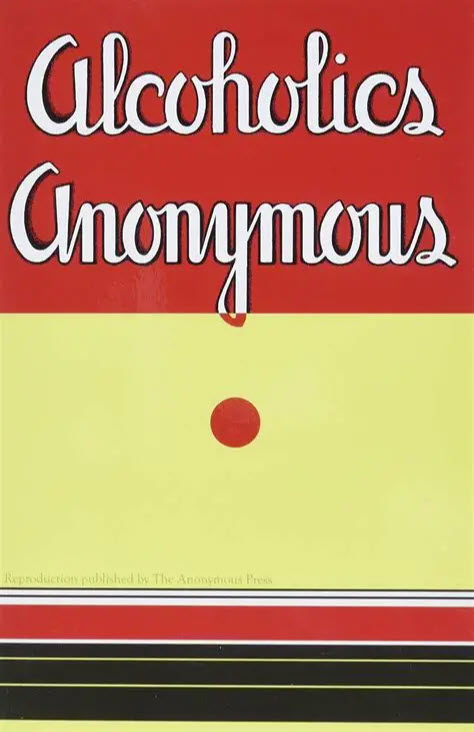
You own a 1939 first edition Big Book — you know what that feels like. Thick, red cloth, no dust jacket if you’re lucky, $3.50 in 1939, now a fortune. That book cost Bill W. everything to write and it still pays the best dividend in AA: one alcoholic helping another. The funny stories are still the best kind — because if you can’t laugh at “The Man Who Mastered Alcohol,” you haven’t read it right.
This page is not just the covers in the collection. It is the story of every book AA has made, why each was made, what’s inside, and how the stories change.
The Oxford Group Roots — Where the Steps Came From
AA did not start in 1935. It started in 1908 with Lutheran minister Frank Buchman’s conversion in Keswick, England. He built the Oxford Group — later Moral Re-Armament — around Four Absolutes: Absolute Honesty, Absolute Purity, Absolute Unselfishness, Absolute Love. Practice was simple: share in meetings, make restitution, listen for Guidance, and surrender self.
Bill Wilson was brought to the Oxford Group in December 1934 by Ebby Thacher. Dr. Bob Smith had been in Oxford Group meetings in Akron since 1933. Early Akron AA was an Oxford Group meeting: you admitted defeat, you inventoried, you confessed, you made amends, you prayed, you carried the message. In 1937, Bill and Bob split from the Oxford Group because they wanted to help alcoholics only, no church affiliation, no requirement to accept the Four Absolutes as absolutes. Bill kept the structure — it became the Twelve Steps — but dropped the moral absolutism. That’s why the Big Book never says “Absolute” — it says “We tried.”
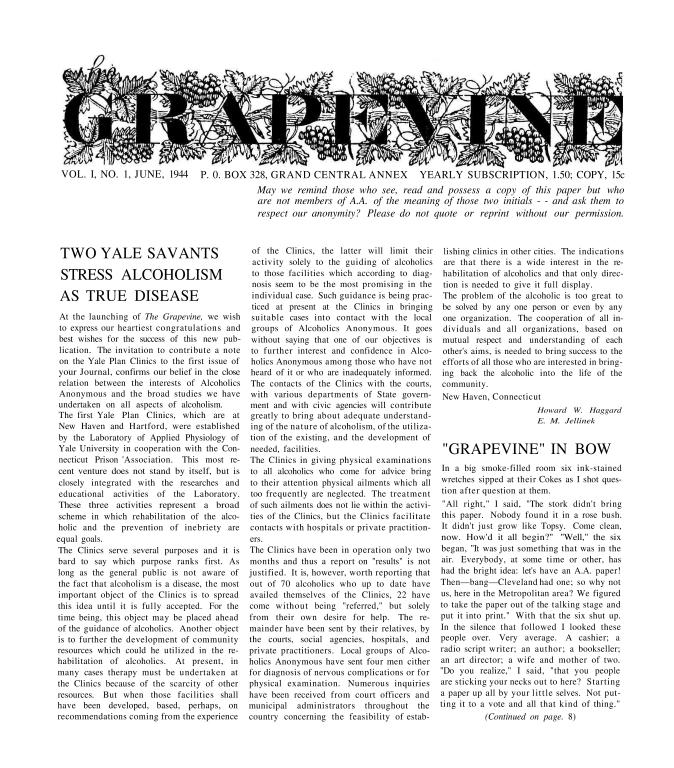
Grapevine’s 1960s issues still reprint Oxford Group maxims. If you read “First Things First” and “Easy Does It” on early Grapevine covers, those are Oxford slogans, secularized.
The Big Book — Alcoholics Anonymous (1939): The Original Manuscript
Writing: Bill wrote the Big Book in 1938 in Hank Parkhurst’s office at 17 William Street, Newark, NJ, and at Clinton Street. He wrote longhand, Lois typed. Chapters were read aloud at meetings for approval. Works Publishing Company was created to publish it because no publisher wanted it.
1939 First Edition: 4,730 copies, red cloth, white dust jacket, price $3.50. Original manuscript had no “Doctor’s Opinion” page numbers, and the stories were not yet titled. There are 29 stories in the first edition — and yes, they are the funniest and rawest. “The Unbeliever” (later Jim), “The European Drinker,” “A Vicious Cycle,” “The Man Who Mastered Alcohol” — stories Bill hand-picked because they showed different types: the businessman, the farmer, the woman. Your copy likely still has “Annie the Cook” and “The Rolling Stone” that were cut by the second edition.
What’s Inside — Chapters: The first 164 pages never change — Bill insisted they are the program:
- Forewords: Every edition has a new foreword explaining what changed.
- The Doctor’s Opinion: Dr. William D. Silkworth’s letter — “allergy of the body, obsession of the mind.” This is the medical justification Bill needed.
- Bill’s Story: Bill’s drinking, the famous 1934 hospital window, Ebby’s visit, the light in Towns Hospital.
- There Is A Solution: The “we” chapter — 100 men, no musts, just “we.”
- More About Alcoholism: The jaywalker analogy, the man who can’t stop eating, the spiritual malady.
- We Agnostics: Written to the intellectual — “Lack of power was our dilemma.”
- How It Works: The Steps themselves, pages 58-71. Every meeting reads this. The promises are here.
- Into Action: Steps 4-9 practical instructions — inventory, amends, how to make direct amends without harm.
- Working With Others: Sponsorship before we called it sponsorship.
- To Wives, The Family Afterward, To Employers, A Vision For You: Early outreach — now dated, but shows AA was trying to reach everyone.
The Stories — Why They Change Every Edition
Bill always said the stories prove the program works, not the chapters. Each edition updates stories to reflect AA’s changing membership:
1st Edition (1939): 29 stories — all white, mostly male, New York/Ohio businessmen. Titles like “The Man Who Mastered Alcohol” — ironic, he didn’t. The humor is brutal honesty: “I was a champagne drinker who switched to beer to control it.”
2nd Edition (1955): 42 stories. Adds women (“A Woman’s Story” — Marty Mann), Black member (“The Vicious Cycle” is retained but “The European Drinker” cut), youth. Adds Appendix of Twelve Traditions for first time. This edition sells because 1955 St. Louis convention endorses it.
3rd Edition (1976): Keeps Bill’s story + Dr. Bob’s Nightmare, adds 41 new stories including “A Late Start” (elder), “The Lawyer,” “Gratitude in Action.” Removes some 1939 stories now seen as too rough.
4th Edition (2001–present): 42 stories again — 8 retained from 1st edition, 34 new, deliberately diverse: LGBTQ, Native American (“The Color of Fear”), young person (“A Young Man’s Story”), Muslim, veteran with PTSD. Your 1939 has the best one-liners, but 4th edition is the most inclusive.
Collectors compare editions by which stories survive. “Doctor, Alcoholic, Addict” (Paul O.) and “He Sold Himself Short” (Earl H.) appear in speaker tapes you have in /php/speakers.php — those are Big Book story authors who became circuit speakers.
The Big Book Speaker Study — Joe & Charlie and Why It Matters
Since the 1970s, Joe McQuany and Charlie Parmley’s “Big Book Comes Alive” tapes (recorded in Little Rock) have taught AA how to actually work the book line-by-line. Their 4-day seminar explains: Page 20 is not suggestion, page 44 defines the bedevilments, page 62 is self-will run riot, page 86 is nightly inventory. Every AA book after 1939 is commentary on those 164 pages. If you own the Big Book, you need Joe & Charlie notes in the margins — that’s what speaker studies do.
All the AA Books — In Order They Were Written
1939 — Alcoholics Anonymous (Big Book): The basic text. More than 40 million copies.
1953 — Twelve Steps and Twelve Traditions (12&12): Bill writes 24 essays expanding each Step and Tradition. First serialized in Grapevine 1952-53. This is the “why” behind the “how” in the Big Book.
1957 — Alcoholics Anonymous Comes of Age: Bill’s history — Oxford Group, Rockefeller, Traditions battles. Last book Bill wrote solo before his 1961 LSD experiments.
1962 — Twelve Concepts for World Service: How AA governs itself — upside-down service structure. Dry but essential.
1967 — As Bill Sees It (formerly The AA Way of Life): Selections from Bill’s Grapevine writings and letters — his “Language of the Heart” series.
1975 — Living Sober: Practical tips from Grapevine readers — how to stay sober at parties, work, holidays. Originally Grapevine “Practical Experience” columns.
1980s — Came to Believe (1973), Daily Reflections (1990), Experience, Strength & Hope (2003): Anthologies of Grapevine stories by topic — daily readers that keep Grapevine alive.
1990 — Daily Reflections: A reflection for each day, all taken from Grapevine 1944–1990. Most groups read it alongside Big Book.
2000s — Language of the Heart, Thank You for Sharing, etc.: Best-of Grapevine by decade — exactly what you archive in /php/1940s.php to /php/2020s.php. Each book is curated from the covers you preserve.
La Viña, Grapevine Books: Spanish Grapevine since 1996, French since 1950s. AA publishes in 100+ languages now — but every translation still starts from those 1939 first 164 pages.
Why Your 1939 Matters
Your 1939 first edition is not just valuable. It is evidence. Bill hand-picked stories that made alcoholics laugh at themselves — “The Car Smasher,” “The Fearful One.” He wanted you to see yourself, not admire someone else. Later editions sanitized some humor, but the originals are raw: men losing jobs, wives leaving, yet telling it with a wink. That’s why you’re right — the best kind is funny. It means the ego is finally small enough to laugh.
Every book AA made after 1939 — 12&12, Concepts, Living Sober, Daily Reflections — is an attempt to explain what Bill couldn’t fit in those first 164 pages. The Big Book is the textbook; the rest are footnotes from members who lived it.
Use the search below to find any AA book cover by year (e.g., “1939,” “1953,” “1975”) or title. Click to enlarge. All images are stored in /images/aa_books/ and preserved for historical and educational purposes, just like the Grapevine archive in /php/fullarchive.php and the posters in /php/alcohol_posters.php.